
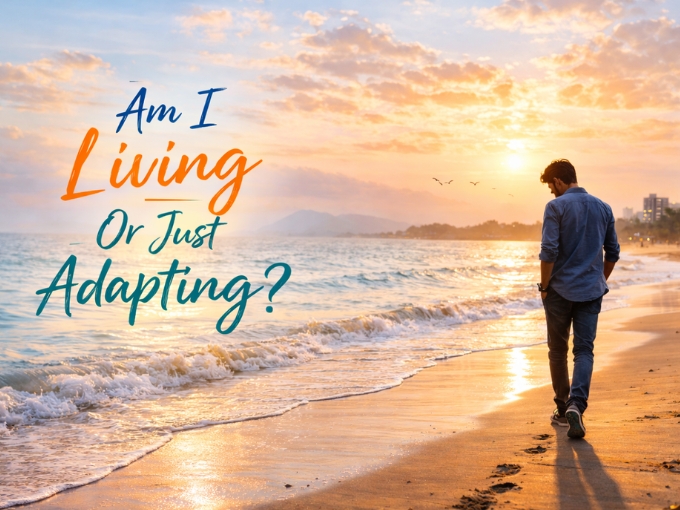
Let me ask you something gently.
Have you noticed how you are slightly different with different people?
One version with your parents. One with your partner. One at work. And a very quiet, private version when you’re alone.
We call this maturity. Adjustment. Social intelligence.
But at what point does the slow adjustment disappear?
Most of us didn’t consciously decide who we are. We adjusted to it.
Maybe you became:
None of these are fake. They were intelligent responses. At some point, you sensed what kept things smooth. What avoided conflict. What brought appreciation. What made you feel secure. So you shaped yourself accordingly.
That’s not a weakness. That’s emotional intelligence at a young age. But if you wear a role long enough, it stops feeling like a role. It starts feeling like an identity.
If you smile when uncomfortable often enough, it becomes automatic. If you suppress anger enough times, you stop recognizing it. If you overachieve to feel worthy, rest starts feeling unsafe. You don’t consciously choose these anymore. Your body just knows the script.
You might think: “I’m just calm.” But maybe you were trained not to react. “I don’t need much.”
Or maybe you learned not to ask. Sometimes we confuse adaptation with personality.
This doesn’t show up dramatically. It shows up as subtle tiredness.
You feel drained after socializing — even when it was nice.
You rehearse conversations before they happen.
You feel relief when plans get cancelled.
You struggle to answer, “What do you feel like doing?”
It’s not that you don’t have preferences. It’s that you’ve been adjusting them for so long, you don’t immediately hear them. And that’s exhausting.
If you’re unsure whether you’re living or adapting, notice your body.
Do your shoulders tighten before you speak?
Does your stomach clench when you want to disagree?
Do you smile automatically when something feels off?
Does your breath become shallow when you say “yes”?
The body often signals misalignment before the mind explains it.
Instead of analyzing immediately, try this:
When you feel that tightening, don’t rush. Take one slow breath. Even 5 seconds creates space.
“What do I actually want to say right now?” Not what sounds right. Not what keeps peace. Just what is true.
You don’t need a dramatic declaration.
Begin with small honesty:
Small truth builds internal safety. You are teaching your nervous system that authenticity is not dangerous.
Reclaiming yourself doesn’t mean becoming harsh or rebellious. It doesn’t mean confronting everyone. It means reducing self-abandonment. It means not overriding your own signals every single time. You can still be kind. Still be loving. Still be responsible. Just not at the cost of disappearing.
Adapting helped you survive. Living helps you feel alive.
Adapting says, “What does the room need?” Living asks, “What do I need?”
For a long time, you may have prioritized harmony, approval, stability. That was wise. But maybe now, in this phase of your life, safety doesn’t require shrinking. Maybe it allows expression. You don’t have to reinvent yourself. You just have to stop editing yourself so much.
And maybe mental health, sometimes, is simply this:
Not performing calmness. Not performing strength. Not performing perfection.
But allowing yourself to exist — fully, honestly, and without constant adjustment.
That’s not selfish. That’s integration.
